To start with the development of our project we first had to have a theme. For this we sat together in our team (Linde, Suzanne, Tjeerd and me) and asked ourselves what would we like to learn? As the only I-Tech student I was chosen to represent the target group, meaning the workshop should be possible for me to do. To get inspiration we looked at the Robotics and Industrial design engineering (IDE) courses Suzanne and Linde were respectively doing. We tried to answer the question, what are you learning that I-Tech students should learn as well and what is something you did not learn in CreaTe that you would have liked to learn to prepare for your current courses.
This led us to the following topics:
Programming languages (R)
Brand management
Origami
3D printing
I also thought of the courses I was currently taking that I enjoyed and believed to be useful for all students to learn which gave the topic of Musique Concrete. Asking ourselves what was unique to our programs and what we would have learned gave us a good basis to work with.
Making a workshop for programming languages was decided to be very digital so that idea was discarded. Brand management is a subject that I-Tech students can take as well, and we could not think of a way to incorporate tinkering in the workshop so that was discarded as well. When discussing Music concrete, we decided it was a bit too much of an artistic topic and would not be useful to learn thus we switched from Musique concrete to Foley which is similar but a bit more useful to learn, according to us.
This left us with three topics:
3D printing
Origami
Foley
We decided that was a sufficient for the session and to meet up later in the week to work on our presentation.
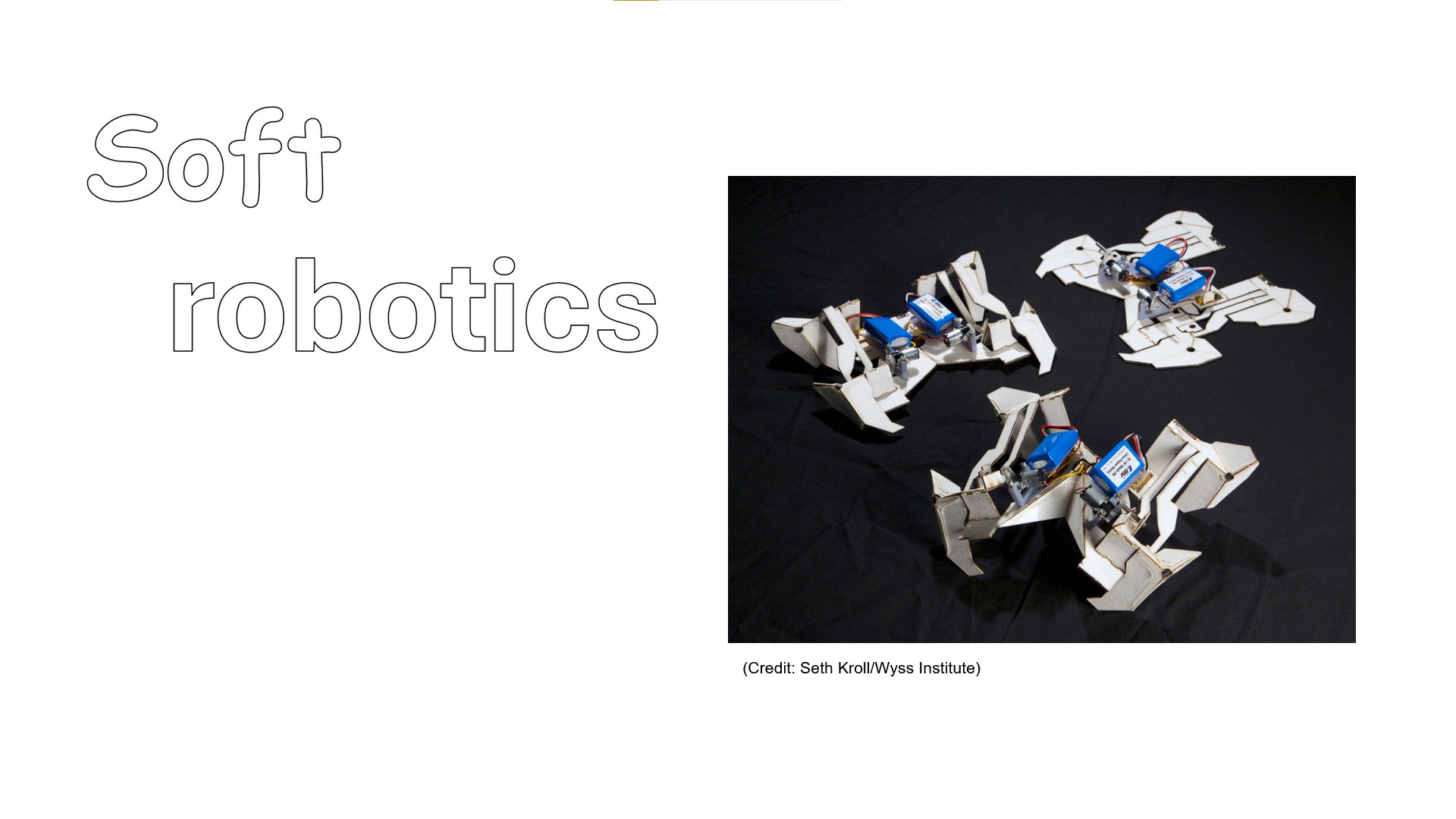
At the meeting later in the week we expanded on our ideas from the session. For the origami we looked at examples of origami in robotics. Suzanne told us about soft robotics and how that type of movement works. Based on that idea we believed it would be a good idea to use ballons to allow origami to extend. The task we could think of was to make a robot work.
For the Foley I explained what I had learned about it in my Storytelling through Sound course. We thought the best way to allow people to experiment would be for them to make Foley for a video. However, this would mean that a large part of the workshop would be digital which we did not want. Thus, the next logical step would be to make sound effects during a theatre performance. The obvious problem there would be that if you are doing something in real life you no longer need to make Foley because the sounds are there already. Therefore, we went back to our original video idea and decided the physical working with objects to make sounds would be physical enough.
The last topic was 3D printing which we wanted to make more practical to teach students how to prevent common mistakes. For this we wanted students to ‘’become’’ the 3D printer themselves by making things from layers. At first, we discussed hot glue as a way to represent 3D printing, but Suzanne correctly pointed out that this would take too long to dry. That is why we ended up with foam as this would allow for layers but would not be too sturdy. The topics we wanted to focus on were bridging and supports.
Tjeerd was tasked with the design of the presentation as it something he enjoys and excels in.
Topic presentation and Research into ideas (Session 4/ Week 5)
In this session we pitched our three ideas. The main feedback was that the origami topic allowed for the most amount of freedom. It had the most Tinkering possibilities as there were many ways to go. The other two topics were more closed off as they had assignments to complete and not a playground to explore.
Based on this feedback, we went with the origami topic. Some additional feedback we had gotten on this topic was that balloons took away from the uniqueness of origami and that using only folds would allow for a more unique experience. After this short discussion at the end of the class we decided to meet up again later in the week.
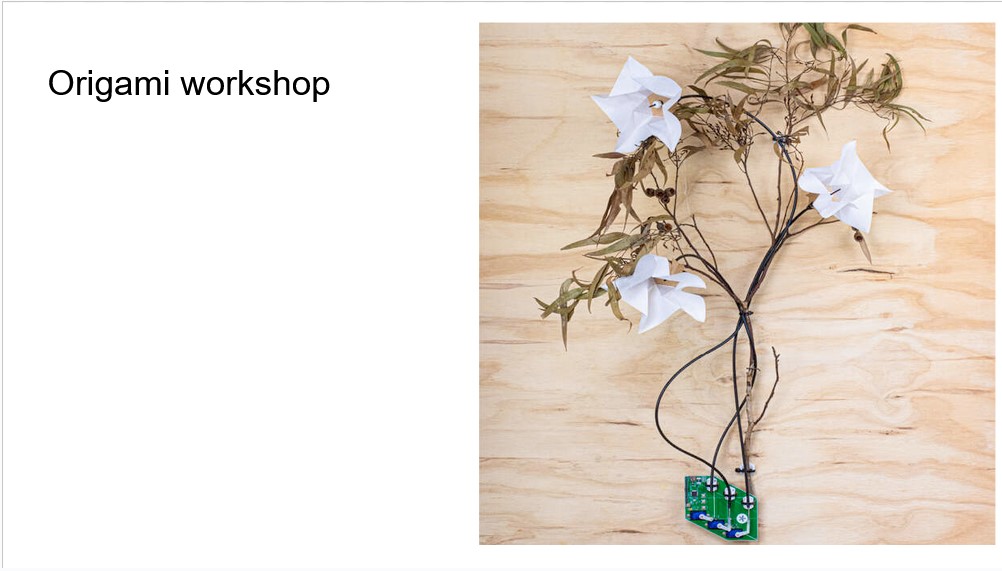
In the next meeting we worked on expanding our workshop plan. As discussed above we went away from balloons and more focused on folds. During this meeting I found the term of Action Origami. These are origami patterns that allow for movement and thus would work great for our workshop. At the end of the session this week we were also told to look up Matthew Gardner as he also used with Origami and robotics. While looking at his site we quickly found out he is more of an artist than an engineer. His creation closed to our idea was an origami flowers kit with flowers that open and close. These do not have a practical use, so we focused more on the action origami in our workshop design. Looking back on this, it might have been good to look more into the origami flowers especially the facilitation done in the kit. During our planning we also discussed the use of Servos to make origami movement possible and decided that it should work and that we should therefore add them to our workshop.
Source: Oribokit - Origami and Robotics Kit (no date). Available at: https://oribokit.com/ (Accessed: 16 April 2025).
Working on prototype and figuring out origami (week 6 and 7)
Now that we had our idea and had gotten positive feedback on our idea during the second presentation it was time to start exploring origami and if there were ways to make it move. During our entire process we focused nearly entirely on origami and how to work with it. It might have been good to pay more attention to the facilitation, but we really wanted for the origami to work. Furthermore, the assignments and topics focused on facilitations were not uploaded on Canvas and the session did not happen because of the UT strike. Did this focus on the origami itself did allow for a large amount of tinkering which was good for our learning experience.
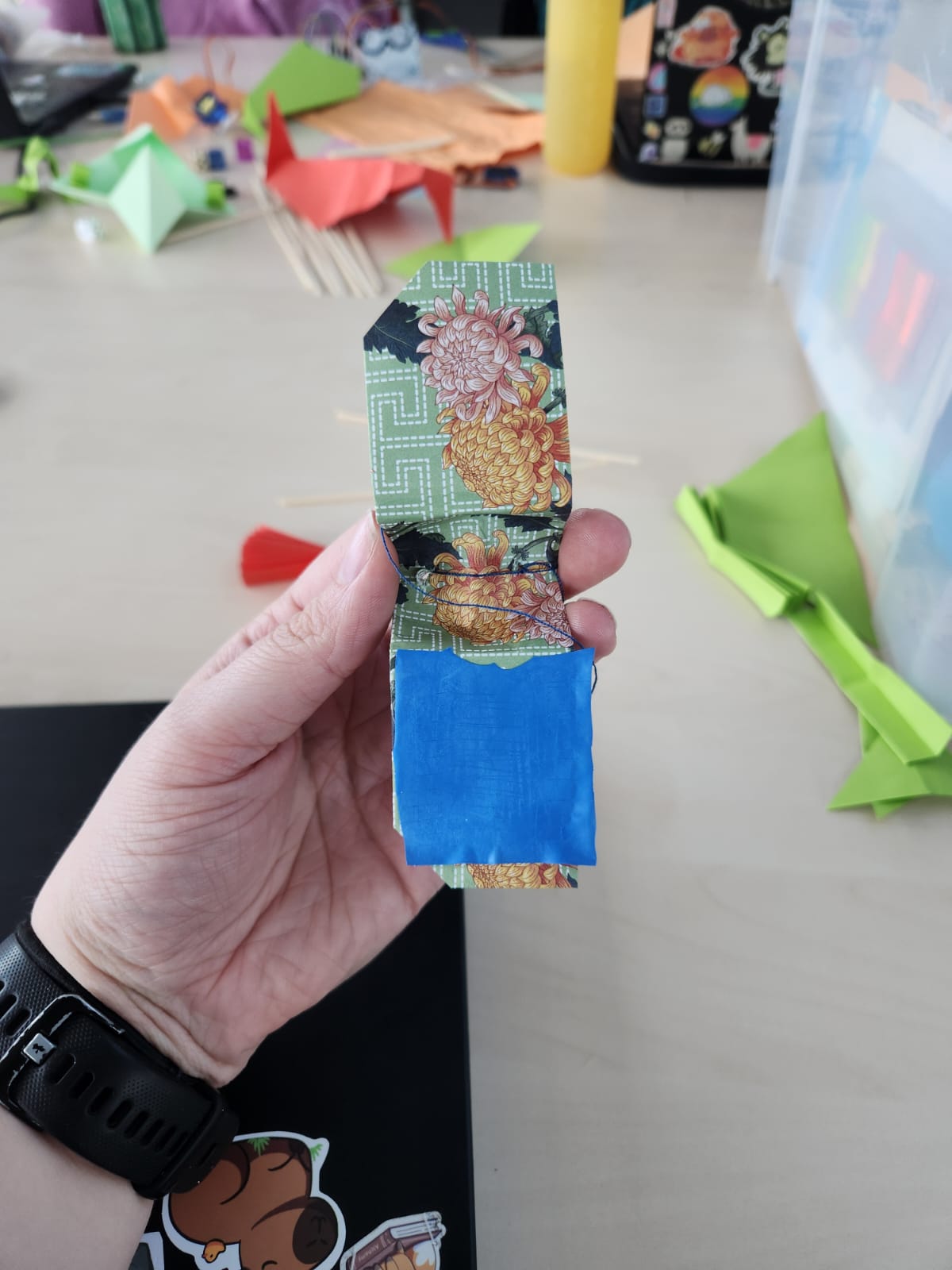
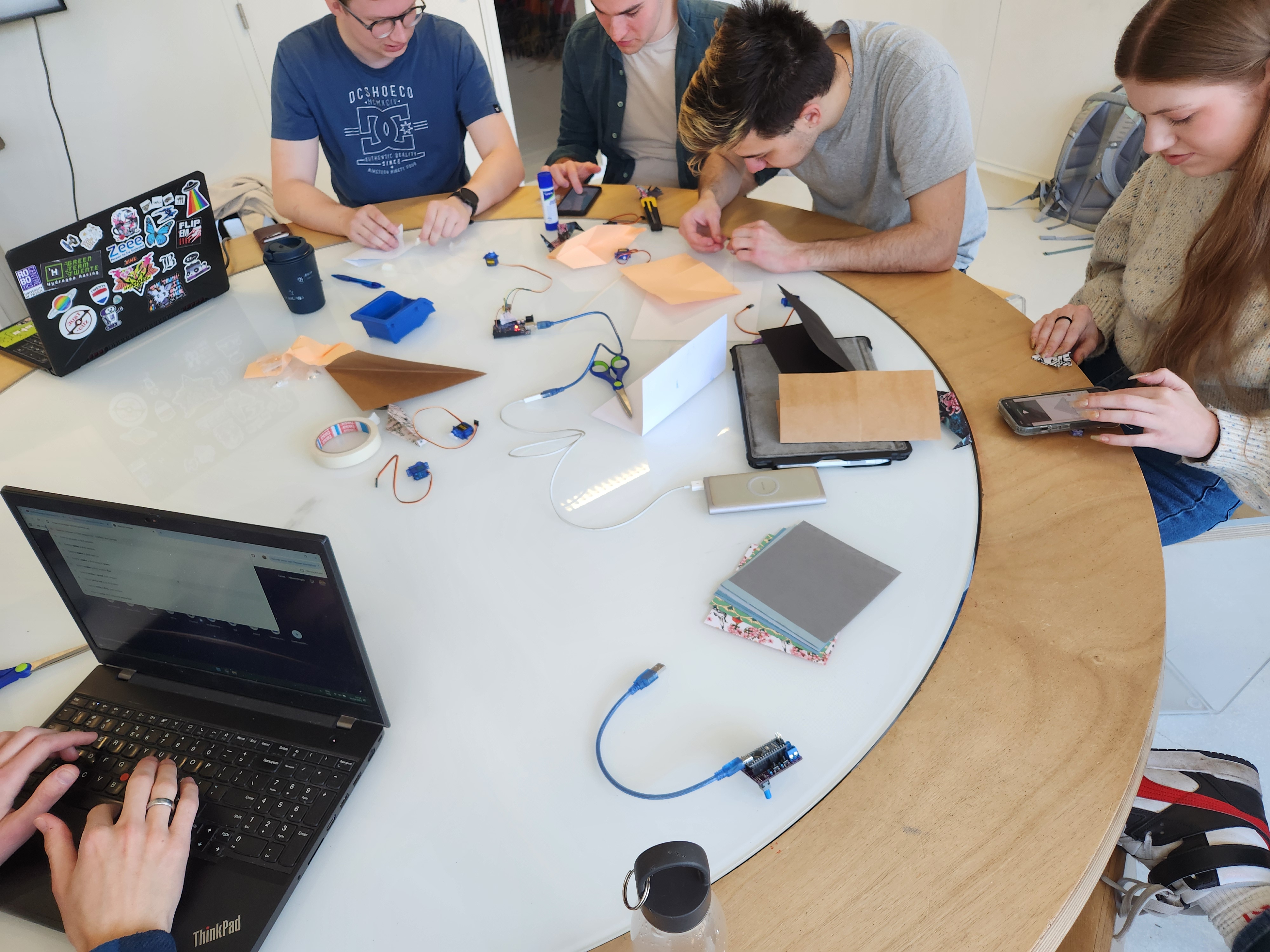
We started our exploration by looking up action origami and trying them out. I made a pecking bird pattern. Linde tried the butterfly. Suzanne started with a butterfly and then tried to attach servos and Tjeerd also made a pecking bird after which I tried to make his own patterns. After the butterfly Linde tried to make a peacock. I tried to make a spring because I believed this would offer us a lot of possibilities for movements. I attempted the spring multiple times with different patterns, and I unfortunately never got a working version. This continued failure did make it clear that the pattern was difficult to complete and prompted us to declare it outside the scope of our workshop. I did not like that I was unable to complete the spring, but it did teach me that at some point using another method can get you better results.
Of the other three Tjeerd ended up being the most successful as he was able to make a movement happen with his own pattern. He did have to go through a few iterations as he first started with basically making an arm with paper which was not origami. I believe the reason Tjeerd was more successful than the rest of us was because he tried things himself without trying to get a pattern that would fit his needs. This is something I can definitely learn from him as I often rely on patterns and feel scared to just go wild. Especially in crochet I could try to be freer. After getting good movement Suzanne used Tjeerd’s pattern to make a walker with moderate success. Now that we had a successful prototype we started working on our session. Worried about the “penguin problem” We decided to not show our solution during our workshop and only give them examples of the folds so the students could tinker in the same way as we could.
User testing/ session try-out (Week 8)
Now that we had found at least one way to make an origami robot, and the end of the module was nearing it was time for user testing. For the user testing we invited 4 other students from the course to take part in a shortened version of our workshop of around an hour.
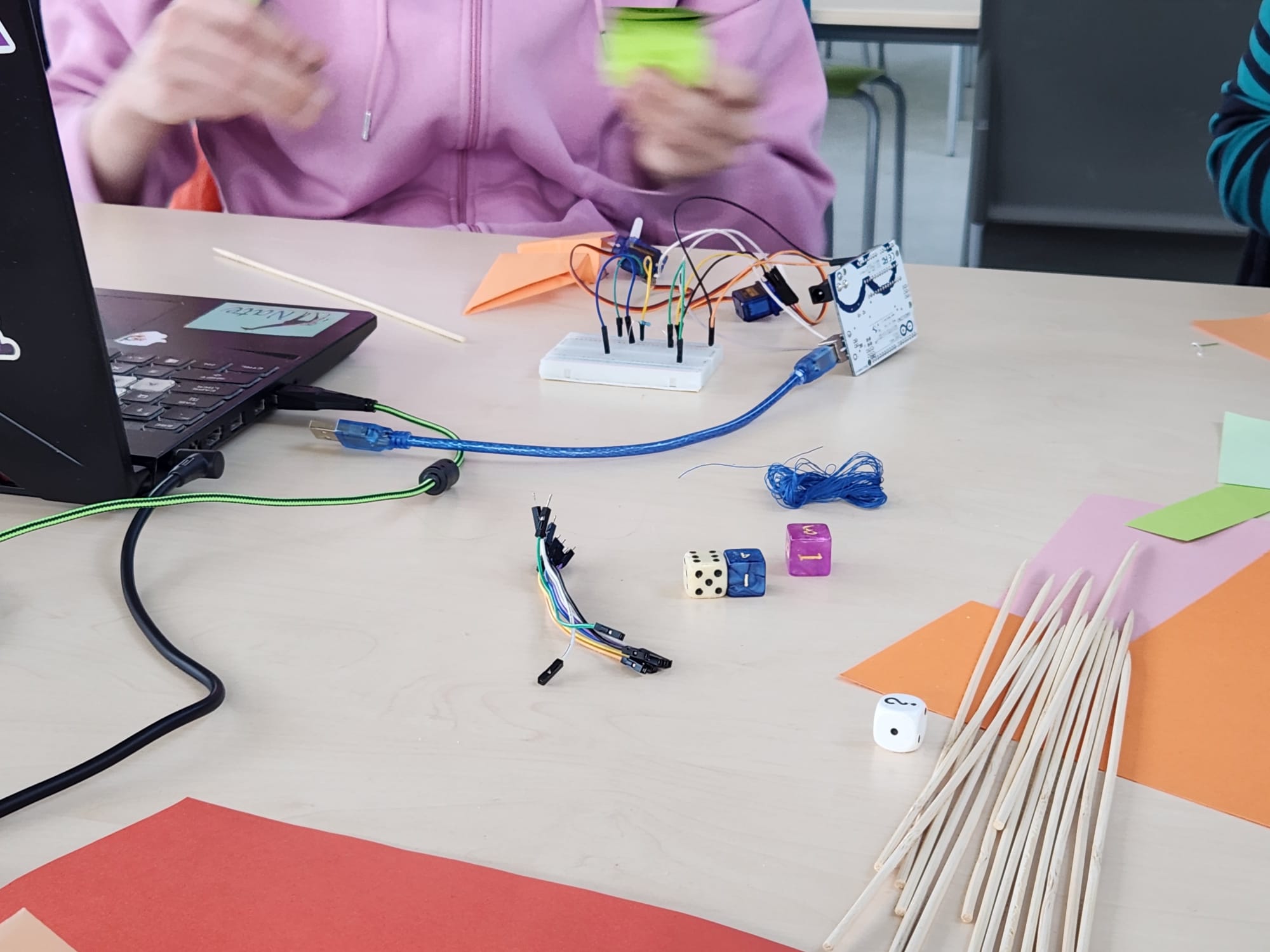
The workshop worked as followed: Explaining the idea of origami and explaining the goal of the workshop: Moving a ping pong ball with origami robotics. Next, we showed how to make the pecking bird while the participants followed along. Then with that knowledge the participants were free to tackle the challenge. To help them they were provided with paper, split pins, servos, thread and instructions for two more origami patterns.
Inspired by the pecking bird, the participants looked up a frog origami pattern. Having gained some experience with origami, they were able to follow this pattern. With the use of a servo, they were also able to make the frog move and move the ping pong ball. We were very surprised by their solution to the problem. We were expecting that they would make an arm or something, but their solution did work even if it did not move the servo.
Some feedback we received was that the rules for what was allowed and what was not were unclear. We realised that it would indeed be a good idea to have a rule explanation at the beginning of the session.
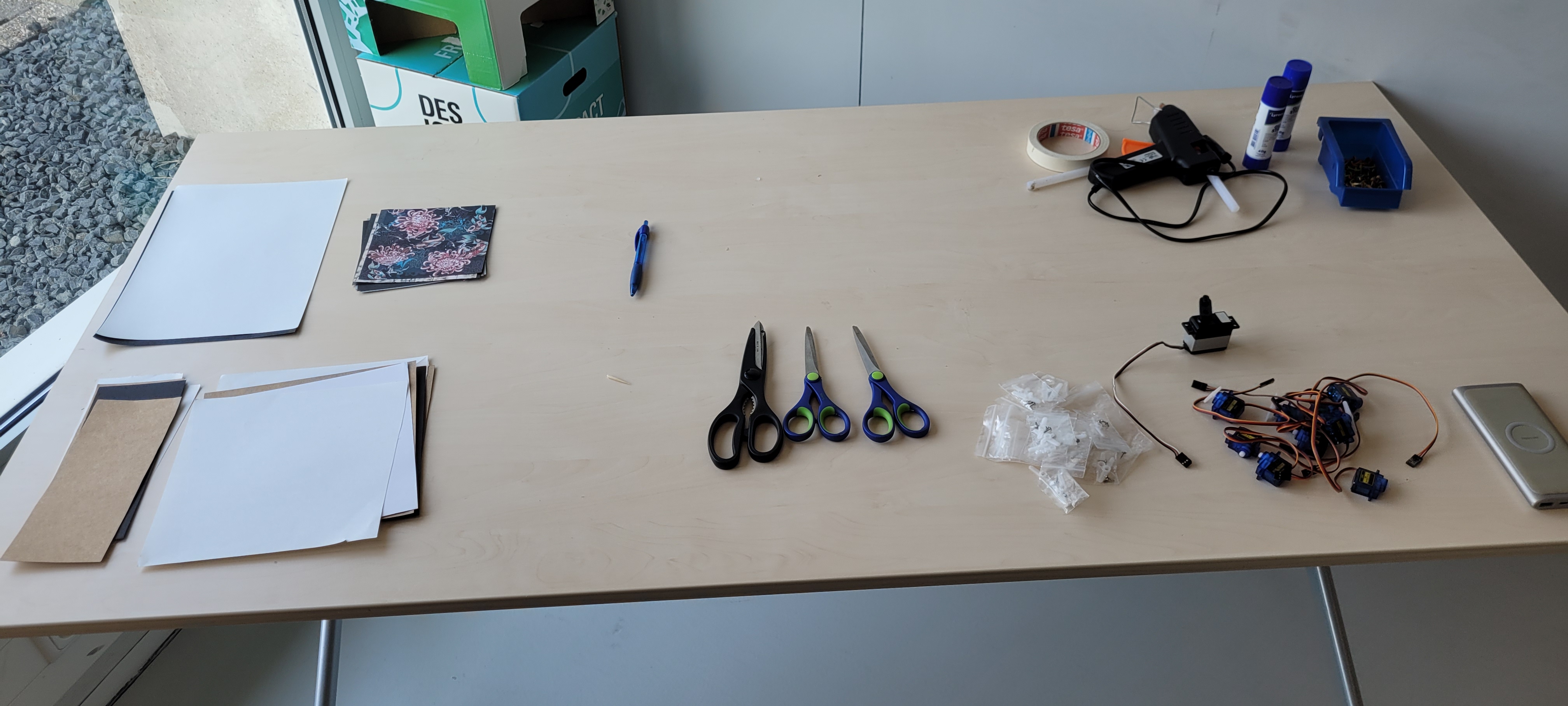
Presentation/ demo session (week 9) During the informal demo session, we did not have time to do the entire session, so we made an even shorter version where people were only explained how to make the pecking bird and were then free to try and make it move. For this we provided people with the instructions, paper, thread split pins and servos. We had two different servos; one had a potentiometer attached to make testing easier, the other just moved right to left in a constant pattern. During this demo session it became clear the testing servo was very much preferred and having more would be nice. Another thing was that the picture instructions were not clear enough so I made physical versions of every step so people could hold those and feel and see what they needed to do. Linde said it helped a few people, but I did not see this myself as after I made them, I went to look at the other groups. Even with the restrictions multiple people got their origami moving and even more people at least made an origami bird.
Most of the time Linde and I were the ones explaining as Suzanne was checking the other group’s work and Tjeerd had another subject at the same time. As more people did the demo Linde and I became better at explaining what to do. We also became surer of what needed to be said and what could be left out.